

Are We Actually Coaching Everyone?
This might be one of the simplest tools in the bundle—and one of the most revealing.
During a practice, we feel like we’re watching everyone.
We probably are not able to. Or if we are, we aren’t likely to simply remember what we see.
Certain athletes naturally get more coaching attention.
The player involved on the ball gets feedback.
The athlete struggling gets feedback.
The vocal player gets noticed.
The player standing closest to us gets coached.
Meanwhile, another player may go through large portions of practice without receiving meaningful individual feedback.
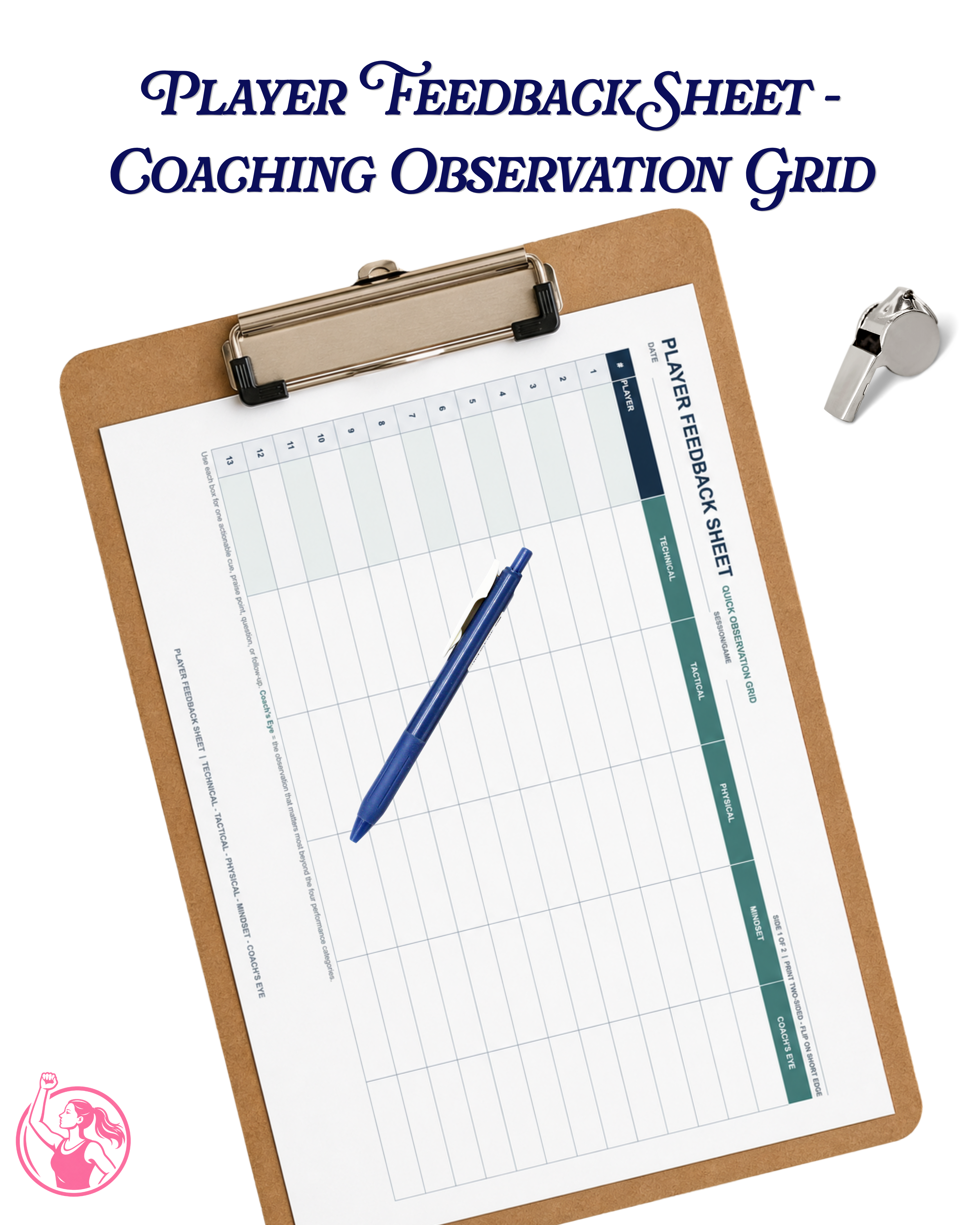
So I built a Player Feedback Sheet / Coaching Observation Grid for my team and coaches.
The idea is simple
Track who you’re actually coaching.
During training, I—or another member of the staff—can mark interactions, observations, feedback, or coaching contacts.
Over time, patterns appear.
Maybe we’re spending significantly more time with our attackers.
Maybe starters are receiving more detailed tactical feedback than reserves.
Maybe one quiet athlete hasn’t had a meaningful coaching interaction in several practices.
That’s important information.
I don’t use it to create quotas
This isn’t:
“Every player must receive exactly three coaching interactions.”
Coaching isn’t that mechanical.
Instead, it’s an awareness tool.
It allows us to ask:
Who are we seeing?
And just as importantly:
Who might we be missing?
For a staff working with a large roster, that matters enormously.
Sometimes improving coaching isn’t about finding a new drill.
It’s about becoming more intentional about who receives our attention.
THE SYSTEMS BEHIND THE STAFF
This article is part of a six-part series exploring the tools and systems I use to organize my coaching staff, plan our training, prepare for competition, and create more intentional feedback for our athletes.

Leave a Reply